

Get your daily news on media and advertising
Provided by AGP
Synthetic Rubber Market to Reach USD 41.60 Billion by 2032 at 4.58% CAGR
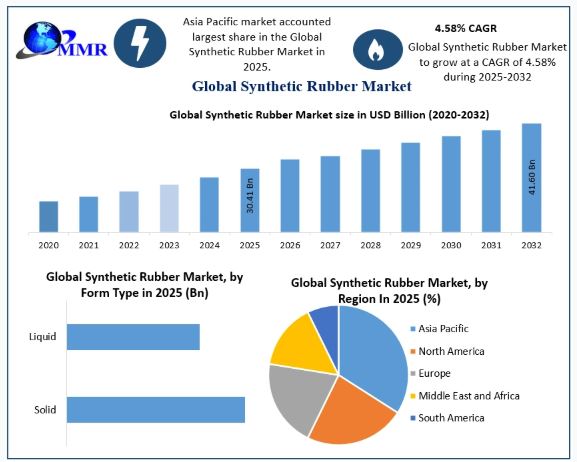
Global Synthetic Rubber Market
Global synthetic rubber market is projected to grow at 4.58% CAGR through 2032, fueled by EV adoption, sustainable tires, and industrial demand.
Sustainability and electric mobility are accelerating innovation across the synthetic rubber value chain worldwide”
GREATER LANDON, LANDON, UNITED KINGDOM, May 12, 2026 /EINPresswire.com/ -- The global Synthetic Rubber Market was valued at USD 30.41 billion in 2025 and is projected to reach nearly USD 41.60 billion by 2032, expanding at a CAGR of 4.58% during the forecast period, according to Maximize Market Research. The industry is witnessing strong momentum driven by rapid industrial transformation, increasing automotive production, rising electric vehicle demand, green chemistry expansion, and accelerating investments in advanced chemical manufacturing technologies. — Maximize market
Synthetic rubber has emerged as one of the most strategically important materials in the global specialty chemicals ecosystem. Its extensive use in tires, automotive components, industrial machinery, construction materials, medical applications, footwear, and high-performance engineering products is reshaping industrial demand patterns worldwide. Manufacturers are increasingly investing in sustainable production technologies, AI-powered manufacturing systems, advanced elastomer formulations, and circular economy initiatives to align with ESG-focused industrial transformation goals.
Get a sample of the report: https://www.maximizemarketresearch.com/request-sample/513/
The growing transition toward electric mobility, lightweight materials, fuel-efficient vehicles, and high-performance industrial applications is further strengthening the long-term outlook for synthetic rubber manufacturers globally. Advanced grades such as styrene-butadiene rubber (SBR), polybutadiene rubber (BR), nitrile rubber (NBR), and ethylene propylene diene monomer (EPDM) are gaining widespread adoption across automotive, aerospace, electronics, healthcare, and infrastructure sectors.
According to Ankita Kagawade, Research Manager at Maximize Market Research, “The Synthetic Rubber Market is entering a transformative phase where sustainability, AI-driven manufacturing, specialty elastomers, and supply chain modernization are becoming core competitive differentiators. Companies are aggressively investing in green chemistry technologies, bio-based feedstocks, advanced recycling systems, and smart manufacturing infrastructure to address rising industrial demand while meeting stringent environmental regulations. The future of the market will be shaped by innovation-led production ecosystems and regional manufacturing expansion strategies.”
Specialty Chemicals Boom and Industrial Demand Accelerate Market Expansion
The synthetic rubber industry is benefiting significantly from the expansion of the global specialty chemicals sector. Rising demand for durable, heat-resistant, lightweight, and high-performance materials across industrial applications is fueling adoption globally.
Automotive manufacturers continue to remain the largest consumers of synthetic rubber due to growing tire production, electric vehicle manufacturing, industrial sealing systems, vibration control products, and advanced automotive components. The increasing adoption of EVs is creating strong demand for specialized elastomers with improved thermal stability, low rolling resistance, and enhanced durability.
Industrial automation trends and manufacturing modernization are also creating opportunities for synthetic rubber producers. Automated production systems, AI-enabled process monitoring, predictive maintenance technologies, and smart factory initiatives are improving manufacturing efficiency while reducing waste generation and energy consumption.
At the same time, sustainability-focused investments are accelerating the commercialization of bio-based synthetic rubber alternatives and recyclable elastomer technologies. Companies are increasingly prioritizing low-carbon production systems and circular material recovery solutions to comply with evolving environmental standards.
Key Market Segments Driving Growth
By Product Type
• Styrene-Butadiene Rubber (SBR)
• Polybutadiene Rubber (BR)
• Ethylene Propylene Diene Monomer (EPDM)
• Nitrile Butadiene Rubber (NBR)
• Butyl Rubber (IIR)
• Chloroprene Rubber (CR)
• Others
Among these, styrene-butadiene rubber continues to dominate due to its widespread use in tire manufacturing and automotive applications. EPDM and specialty elastomers are witnessing rapid growth owing to increasing adoption in electric vehicles, renewable energy infrastructure, and advanced industrial systems.
By Application
• Tire Manufacturing
• Automotive Components
• Industrial Goods
• Footwear
• Adhesives and Sealants
• Construction Materials
• Medical Products
• Consumer Goods
The tire manufacturing segment accounts for the largest share of the market as global automotive production continues to expand. However, industrial goods, healthcare, and specialty construction applications are emerging as high-growth segments due to increasing demand for durable and chemically resistant elastomers.
AI-Driven Manufacturing and Sustainability Reshape Industry Dynamics
The Synthetic Rubber Market is experiencing a major technological transition driven by digital manufacturing and sustainability-led innovation. Major chemical companies are implementing AI-powered manufacturing systems to optimize production efficiency, improve quality control, reduce downtime, and lower operational costs.
Digital twins, real-time process analytics, machine learning-based predictive maintenance, and automated chemical process optimization are increasingly becoming mainstream across modern synthetic rubber manufacturing facilities.
Sustainability initiatives are also accelerating across the value chain. Global producers are investing heavily in:
• Bio-based feedstocks
• Carbon emission reduction technologies
• Advanced recycling systems
• Green chemistry manufacturing processes
• Renewable energy-powered production facilities
• Circular economy material recovery programs
• Sustainable supply chain modernization
These initiatives are helping manufacturers strengthen ESG positioning while improving operational resilience and long-term competitiveness.
Get a sample of the report: https://www.maximizemarketresearch.com/request-sample/513/
Strategic Developments and Competitive Landscape
Leading market participants are focusing on strategic acquisitions, R&D expansion, production capacity enhancement, and regional manufacturing diversification to strengthen their market position.
Several major companies are investing in advanced material innovation programs targeting EV tires, high-performance industrial elastomers, sustainable rubber compounds, and specialty applications.
Recent industry developments include:
• Expansion of sustainable synthetic rubber production capacities in Asia-Pacific and Europe
• Increased investments in bio-attributed and recycled rubber technologies
• AI-enabled manufacturing modernization projects across chemical plants
• Strategic partnerships between automotive OEMs and elastomer manufacturers
• R&D initiatives focused on low-emission and high-durability rubber formulations
• Supply chain localization initiatives to reduce geopolitical and logistics risks
• Technology collaborations focused on advanced tire materials and smart mobility solutions
Major companies operating in the market include:
• Sinopec
• Kumho Petrochemical
• JSR Corporation
• ExxonMobil Chemical
• Lanxess AG
• LG Chem
• Zeon Corporation
• Arlanxeo
• TSRC Corporation
• Asahi Kasei Corporation
United States Market Trends
The United States continues to remain a strategically important market due to strong automotive manufacturing activity, industrial modernization programs, and increasing investments in sustainable chemicals.
The rise of electric vehicle manufacturing and reshoring of industrial supply chains are supporting demand for high-performance synthetic rubber materials. American manufacturers are increasingly investing in AI-enabled production systems, advanced elastomer technologies, and low-carbon manufacturing infrastructure.
Sustainability regulations and ESG reporting requirements are also encouraging the adoption of environmentally responsible rubber manufacturing practices.
United Kingdom Market Trends
The UK market is witnessing increasing demand for sustainable elastomers across automotive, aerospace, healthcare, and industrial sectors. Circular economy initiatives and green manufacturing investments are supporting market expansion.
Advanced research collaborations between universities, chemical companies, and automotive manufacturers are accelerating innovation in recyclable and bio-based rubber technologies.
Germany Market Trends
Germany continues to dominate the European synthetic rubber landscape due to its strong automotive and industrial manufacturing ecosystem.
German manufacturers are rapidly adopting Industry 4.0 technologies, AI-powered production systems, and energy-efficient manufacturing infrastructure. The country’s focus on electric mobility and sustainable industrial transformation is increasing demand for specialty elastomers and advanced tire materials.
Germany’s stringent environmental regulations are also accelerating investments in low-emission rubber production technologies and circular economy solutions.
Japan Market Trends
Japan remains a major innovation hub for high-performance synthetic rubber technologies. Japanese companies are focusing heavily on advanced material science, specialty elastomers, and precision-engineered rubber compounds.
The country’s leadership in automotive manufacturing, robotics, electronics, and industrial automation continues to create long-term growth opportunities for specialty synthetic rubber applications.
Research initiatives related to lightweight materials, fuel efficiency, and sustainable manufacturing are further strengthening Japan’s competitive position in the global market.
South Korea Market Trends
South Korea is emerging as a major growth center driven by strong petrochemical infrastructure, automotive exports, and advanced manufacturing capabilities.
Major South Korean chemical companies are expanding investments in EV-focused elastomers, sustainable rubber technologies, and smart manufacturing systems. Government support for advanced materials innovation and green industrial development is also accelerating market growth.
China Market Trends
China remains the largest manufacturing hub for synthetic rubber production globally. Rapid industrialization, expanding automotive production, infrastructure investments, and strong domestic chemical manufacturing capabilities continue to drive market demand.
Chinese manufacturers are aggressively investing in production capacity expansion, AI-powered chemical plants, advanced specialty elastomers, and sustainable materials innovation.
The country’s focus on electric mobility, renewable energy infrastructure, and advanced industrial modernization is expected to create significant future opportunities for synthetic rubber suppliers.
India Market Trends
India is emerging as one of the fastest-growing synthetic rubber markets due to expanding automotive manufacturing, infrastructure development, industrialization, and rising domestic consumption.
Government initiatives supporting domestic manufacturing, electric mobility, specialty chemicals production, and industrial automation are creating favorable growth conditions.
Indian manufacturers are increasingly investing in modern production facilities, sustainable chemical manufacturing technologies, and localized supply chain ecosystems. Growing tire production and industrial demand are expected to strengthen India’s long-term market outlook.
Get access to the full description of the report @ https://www.maximizemarketresearch.com/market-report/synthetic-rubber-market/513/
Future Outlook: Sustainable Chemicals Revolution Shapes the Next Decade
The future of the Synthetic Rubber Market will be strongly influenced by sustainability-driven innovation, advanced material engineering, AI-enabled manufacturing, and regional supply chain transformation.
The growing adoption of electric vehicles, renewable energy systems, industrial automation, and smart infrastructure is expected to significantly expand demand for specialty elastomers and high-performance synthetic rubber materials.
Manufacturers that successfully integrate green chemistry principles, digital manufacturing technologies, advanced recycling systems, and ESG-focused operational strategies are expected to gain long-term competitive advantages.
Emerging trends likely to shape the market through 2032 include:
• Bio-based synthetic rubber commercialization
• AI-integrated smart chemical manufacturing
• Sustainable tire technologies
• Circular economy rubber recycling systems
• Low-carbon industrial production infrastructure
• High-performance elastomers for EV applications
• Supply chain regionalization and resilience initiatives
• Advanced specialty materials for aerospace and healthcare sectors
As global industries continue prioritizing sustainability, efficiency, and material innovation, synthetic rubber will remain a critical component of the future chemicals ecosystem.
Maximize Market Research states that strategic investments in sustainable manufacturing, regional expansion, advanced material innovation, and AI-powered industrial transformation will define the next phase of growth in the global Synthetic Rubber Market.
Organizations seeking deeper strategic insights, regional opportunity mapping, competitive benchmarking, and future investment intelligence are increasingly leveraging consulting-driven market intelligence solutions from Maximize Market Research to support long-term decision-making in the evolving specialty chemicals
To Related Reports:
Chromatography Reagents Market: https://www.maximizemarketresearch.com/market-report/chromatography-reagents-market/302291/
Carbon Steel Tubes Market: https://www.maximizemarketresearch.com/market-report/carbon-steel-tubes-market/301921/
Chemical Market:https://www.maximizemarketresearch.com/market-report/chemical-market/301671/
Magnesium Chloride Market:https://www.maximizemarketresearch.com/market-report/magnesium-chloride-market/284984/
About Maximize Market Research:
Maximize Market Research is a multifaceted market research and consulting company with professionals from several industries. Some of the industries we cover include medical devices, pharmaceutical manufacturers, science and engineering, electronic components, industrial equipment, technology and communication, cars and automobiles, chemical products and substances, general merchandise, beverages, personal care, and automated systems. To mention a few, we provide market-verified industry estimations, technical trend analysis, crucial market research, strategic advice, competition analysis, production and demand analysis, and client impact studies.
Contact Maximize Market Research:
3rd Floor, Navale IT Park, Phase 2
Pune Bangalore Highway, Narhe,
Pune, Maharashtra 411041, India
sales@maximizemarketresearch.com
+91 96071 95908, +91 9607365656
Lumawant Godage
MAXIMIZE MARKET RESEARCH PVT. LTD.
+91 96073 65656
email us here
Visit us on social media:
LinkedIn
Instagram
X
Legal Disclaimer:
EIN Presswire provides this news content "as is" without warranty of any kind. We do not accept any responsibility or liability for the accuracy, content, images, videos, licenses, completeness, legality, or reliability of the information contained in this article. If you have any complaints or copyright issues related to this article, kindly contact the author above.
