

Get your daily news on media and advertising
Provided by AGP
Aerospace Foam Market Poised for Growth to US$ 10.4 Billion by 2033, Expanding at 6.1% CAGR from 2026
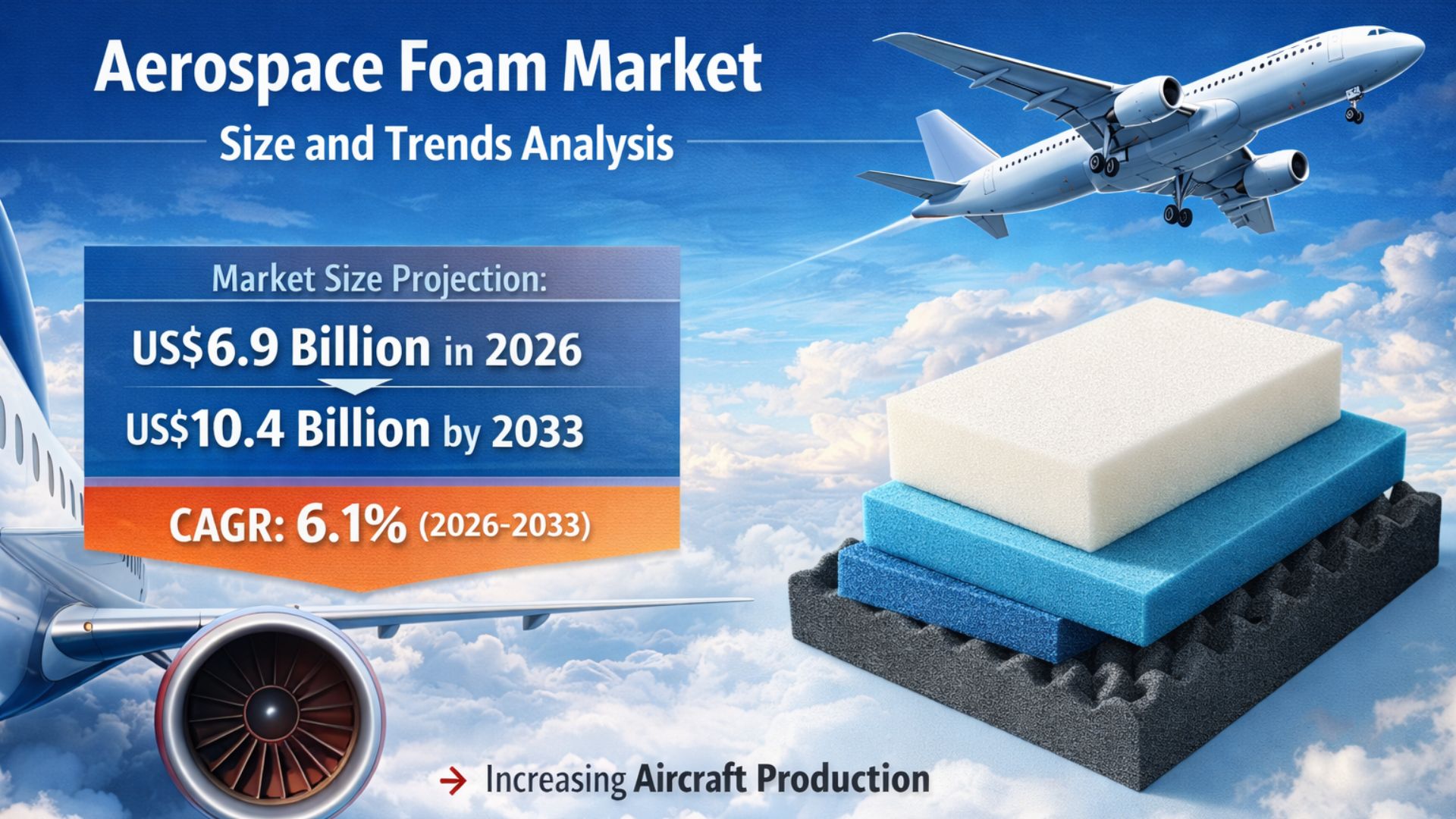
Aerospace Foam Market
Polyurethane foam is anticipated to hold 28.2% of the market share, due to its versatility, cost-efficiency, and widespread use in aircraft interiors
LONDON, LONDON, UNITED KINGDOM, May 11, 2026 /EINPresswire.com/ -- According to the latest study by Persistence Market Research, the global aerospace foam market is projected to be valued at US$6.9 billion in 2026 and is forecast to reach US$10.4 billion by 2033, registering a CAGR of 6.1% between 2026 and 2033. The market is witnessing robust momentum due to increasing aircraft production, expansion of the global fleet, and rising emphasis on lightweight materials, fuel efficiency, and cabin safety standards. Aerospace foams have become critical components across modern aircraft manufacturing, offering superior insulation, vibration control, impact resistance, and weight reduction benefits.
Get Your FREE Sample Report Instantly – Click Now: https://www.persistencemarketresearch.com/samples/36494
Rising Aircraft Deliveries Fuel Market Expansion
The continued growth in commercial aviation and passenger traffic is driving demand for new aircraft deliveries worldwide. Airlines are expanding fleets to meet surging travel demand, while aircraft manufacturers are ramping up production schedules. Aerospace foams are extensively used in seating systems, cabin interiors, insulation panels, and structural applications, making them essential in next-generation aircraft manufacturing programs.
Lightweight Materials Gain Priority in Aviation
Weight reduction remains a key objective for aircraft manufacturers seeking better fuel efficiency and lower emissions. Aerospace foams provide an excellent strength-to-weight ratio, helping reduce total aircraft mass without compromising performance or durability. Lightweight polyurethane, polyimide, and polyethylene foams are increasingly replacing heavier traditional materials across several aircraft components.
Growing Need for Cabin Comfort and Passenger Experience
Passenger comfort has become a major differentiator for airlines. Aerospace foams are widely used in aircraft seating, headrests, armrests, wall panels, and flooring systems to improve ergonomics and travel experience. Enhanced cushioning materials, acoustic dampening foams, and thermal insulation products are contributing to quieter, more comfortable cabin environments.
Stringent Fire Safety and Regulatory Standards Support Innovation
The aerospace sector operates under rigorous fire, smoke, and toxicity regulations. Manufacturers are investing in advanced foam technologies that comply with strict aviation safety requirements. Flame-retardant polyimide and ceramic foams are gaining popularity in high-temperature and critical safety applications, especially in insulation and engine-adjacent components.
Military Modernization Programs Create New Opportunities
Defense aviation programs worldwide are creating significant growth prospects for aerospace foam suppliers. Military aircraft require specialized lightweight materials with superior durability, impact resistance, and thermal performance. Aerospace foams are used in rotorcraft, fighter jets, transport aircraft, and surveillance systems, supporting modernization efforts across global defense fleets.
Get a Customized Market View in One Click: https://www.persistencemarketresearch.com/request-customization/36494
Demand for UAVs and Advanced Air Mobility Expands Scope
The rise of unmanned aerial vehicles (UAVs), drones, and emerging air mobility platforms is opening new avenues for aerospace foam applications. These platforms prioritize lightweight construction, noise reduction, and thermal management. Foam materials are increasingly being integrated into compact aerospace structures, battery housings, and interior systems for electric aviation platforms.
Sustainable Manufacturing Trends Influence Material Choices
Sustainability goals are encouraging aerospace OEMs and suppliers to adopt eco-friendly materials and production methods. Recyclable foam materials, lower-emission manufacturing processes, and waste reduction initiatives are gaining traction. Suppliers are developing sustainable aerospace foam solutions aligned with aviation decarbonization objectives.
Aftermarket and Retrofit Activities Support Revenue Growth
In addition to new aircraft production, retrofitting older fleets is generating strong aftermarket demand. Airlines are upgrading seating systems, insulation, and interior panels to improve efficiency and passenger satisfaction. Replacement demand for worn-out cushioning and gasketing components is further strengthening long-term market opportunities.
Market Segmentation
By Foam Type
• Polyurethane Foam
• Metal Foam
• Polyethylene Foam
• Polyimide Foam
• Ceramic Foam
• Others
By Application
• Aircraft Seating
• Insulation
• Acoustic Dampening
• Structural Components
• Gasketing and Sealing
• Cargo Liners
By Aircraft Type
• Commercial Aircraft
• Military Aircraft
• Business Jets
• Helicopters
• Unmanned Aerial Vehicles (UAVs)
• General Aviation
By Region
• North America
• Europe
• East Asia
• South Asia & Oceania
• Latin America
• Middle East & Africa
For In-Depth Competitive Analysis, Buy Now: https://www.persistencemarketresearch.com/checkout/36494
Competitive Landscape
Market participants are competing through advanced material engineering, flame-retardant technologies, and custom foam solutions tailored for aircraft OEMs and tier suppliers. Strategic collaborations with airlines and aerospace manufacturers are helping companies secure long-term supply contracts. Investments in R&D for lighter, stronger, and recyclable foams are expected to shape the next phase of competition.
Company Insights
The aerospace foam market is moderately consolidated, with leading players focusing on product innovation, partnerships, regulatory compliance, and expansion of aerospace-grade production capacity. Companies are also investing in lightweight composite-compatible foams and sustainable product portfolios.
✦ Zotefoams plc
✦ Rogers Corporation
✦ Evonik Industries AG
✦ BASF SE
✦ DuPont de Nemours, Inc.
✦ Solvay S.A.
✦ Covestro AG
✦ SABIC
✦ Armacell International S.A.
✦ UFP Technologies, Inc.
Future Outlook
The global aerospace foam market is poised for sustained growth through 2033, supported by rising aircraft production, increasing retrofit demand, defense procurement programs, and technological advancements in lightweight materials. As airlines and manufacturers prioritize efficiency, safety, and comfort, aerospace foams will remain indispensable to modern aviation design and performance.
Explore the Latest Trending Research Reports:
• Anthraquinone Market
• Lanthanum Market
About Persistence Market Research:
Persistence Market Research delivers strategic research solutions that drive business growth. Founded in 2012 and registered in England and Wales in 2023 as Persistence Research & Consultancy Services Ltd., we have completed 3,600+ custom and syndicated studies and supported 2,700+ projects for leading research firms. Combining traditional methodologies with modern tools, we provide actionable insights to multinational corporations, consultants, investors, and government bodies, earning strong trust through long-term client relationships.
Ajaykumar Patil
Persistence Market Research
+1 6468786329
email us here
Visit us on social media:
LinkedIn
Instagram
Facebook
YouTube
X
Legal Disclaimer:
EIN Presswire provides this news content "as is" without warranty of any kind. We do not accept any responsibility or liability for the accuracy, content, images, videos, licenses, completeness, legality, or reliability of the information contained in this article. If you have any complaints or copyright issues related to this article, kindly contact the author above.
