

Get your daily news on media and advertising
Provided by AGP
Global Millet Market Set to Reach USD 19.7 Billion by 2034, Plant-Based Diets & Climate-Resilient Crops Drive Expansion
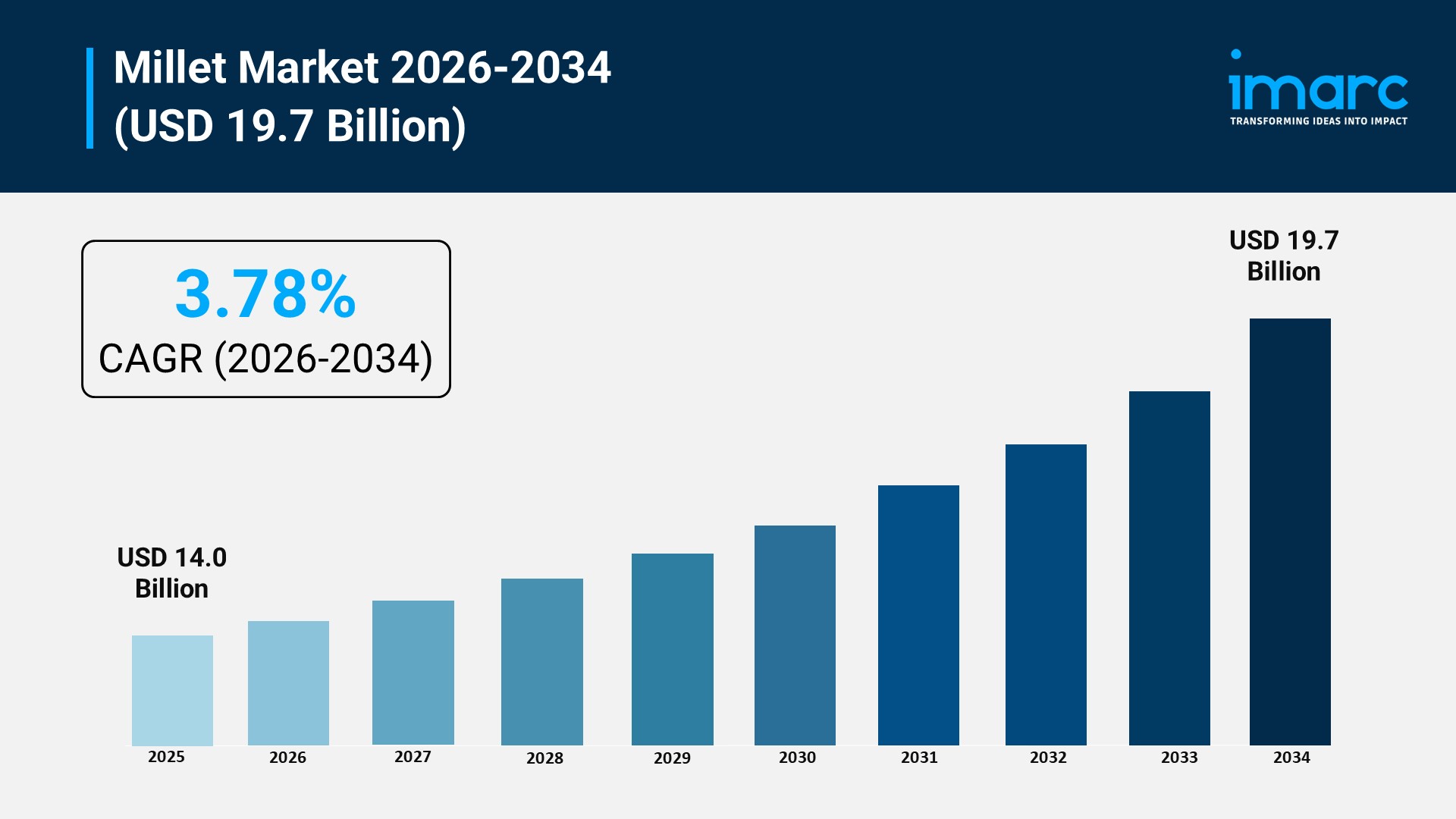
Millet Market Graph 2026
IMARC Group's Latest Research Reveals a CAGR of 3.78% from 2026–2034, with Pearl Millet and Infant Food Segments Leading Expansion
SHERIDAN, WY, UNITED STATES, May 11, 2026 /EINPresswire.com/ -- The global millet market size reached USD 14.0 Billion in 2025 and is projected to climb to USD 19.7 Billion by 2034, expanding at a CAGR of 3.78% during 2026–2034, according to the latest research from IMARC Group. Rising health awareness, climate-resilient agriculture, and a structural shift toward plant-based, gluten-free diets are repositioning millet from a regional staple into a high-growth global superfood category.Asia Pacific leads the market on the back of strong government support, growing health-conscious populations, diverse dietary habits, and large-scale millet production across India and China driving both domestic demand and exports. In 2024, the Government of India launched the Production Linked Incentive Scheme for Millet-Based Products (PLISMBP) with an ₹800 crore budget to support branded ready-to-eat and ready-to-cook millet products with over 15% millet content, signalling the policy ambition behind the category's expansion.
Request for a sample to get detailed understanding about the market: https://www.imarcgroup.com/millet-market/requestsample
What is Driving Global Millet Market's Boom?
The report identifies three core forces reshaping the millet market's landscape:
• Rising Demand for Natural and Clean-Label Foods: Modern shoppers are scrutinising ingredient labels and favouring products free from artificial additives, preservatives, and chemical enhancers. Millet, naturally rich in fibre, protein, vitamins, and minerals, aligns directly with the clean-label movement. In 2024, Ramoji Group launched 'Sabala Millets' with 45 millet-based products focused on preservative-free, nutrient-rich foods that support local farmers and eco-friendly agriculture.
• Growing Role of Media and Awareness Campaigns: Health organisations, NGOs, and food councils are running awareness drives that highlight millet's role in addressing lifestyle diseases and dietary diversity. In 2025, the Agriculture Department of Kashmir launched a millet promotion drive in Pulwama district under the National Food Security Mission, engaging 200 local farmers across pearl millet, sorghum, and finger millet to highlight drought resilience and nutritional value.
• Technological Advancements in Farming and Processing: Automated farming, improved seed varieties, and precision agriculture are lifting yields with fewer inputs. Innovations in milling, storage, and packaging are reducing post-harvest losses and extending shelf life, while digital platforms link farmers directly to markets, improving price realisation and broadening distribution across local and global value chains.
Key Market Insights at a Glance
The following highlights the leading segments by category based on 2025 market leadership:
• Product Type — Pearl Millet: Largest segment by share [exact percentage not available on page], supported by extensive cultivation across India and Africa and broad use across staple food, snack, and animal feed applications.
• Application — Infant Food: Largest segment by share [exact percentage not available on page], driven by the gluten-free, high-fibre, and nutrient-dense profile that aligns with paediatric nutrition guidelines.
• Distribution Channel — Traditional Grocery Stores: Largest segment by share [exact percentage not available on page], anchored by deep penetration in rural and semi-urban markets across Asia Pacific.
• Region — Asia Pacific: Largest regional market [exact percentage not available on page], propelled by agricultural scale in India and China, rising millet-based snack sales, and easy availability across online and offline retail.
• Competitive Structure: A mix of global agribusiness majors and specialised seed companies, including Archer-Daniels-Midland Company, Bayer AG, and Cargill Incorporated, shape supply, breeding, and processing capabilities.
Detailed Segment Analysis
Product Type Insights:
• Pearl Millet
• Finger Millet
• Proso Millet
• Others
Connect for detailed segmentation analysis, ask for analyst: https://www.imarcgroup.com/request?type=report&id=7362&flag=C
Application Insights:
• Infant Food
• Bakery Products
• Beverages
• Others
Distribution Channel Insights:
• Supermarket and Hypermarkets
• Traditional Grocery Stores
• Online Stores
• Others
Regional Insights:
• North America
o United States
o Canada
• Europe
o Germany
o France
o United Kingdom
o Italy
o Spain
o Others
• Asia Pacific
o China
o Japan
o India
o South Korea
o Australia
o Indonesia
o Others
• Latin America
o Brazil
o Mexico
o Others
• Middle East and Africa
Regional Spotlight: Where Is the Action?
Asia Pacific stands out as the largest regional market for millet, supported by considerable growth in the agriculture industry, rising sales of millet-based snack foods, and broad product availability across both online and offline retail channels. India anchors the region with policy-led production support, nutrition programmes, and an expanding processed-food pipeline. China, Japan, South Korea, Australia, and Indonesia round out the region's growth profile.
• Asia Pacific: Largest regional market; led by India and China across production, consumption, and exports.
• Europe: Demand expansion driven by gluten-free, clean-label, and plant-based positioning across Germany, France, the UK, Italy, and Spain.
• North America: Bakery, infant food, and functional food applications scaling across the United States and Canada.
• Latin America: Brazil and Mexico leading category development in snacks and climate-resilient agriculture programmes.
• Middle East and Africa: Traditional production base for pearl and finger millet, with rising local processing investment.
Technology Is Redefining Millet Industry Operations
Modern technologies are reshaping the millet market across the entire value chain. Precision agriculture, automated farming methods, and improved seed varieties are helping growers achieve higher yields with reduced inputs, while enhanced milling, storage, and packaging are extending shelf life and reducing post-harvest losses. Together, these innovations are making millet more commercially competitive against conventional cereal grains.
Food processing technology is unlocking better flavour, texture, and nutritional retention in finished products, broadening millet's appeal across infant food, bakery, beverages, and snacks. Branded launches reflect this shift. In 2024, Marico launched Saffola Masala Millets in two flavours, Masala Delight and Tomato Delight, to position millet as a tasty, affordable, and accessible household snack. Earlier, in September 2024, McDonald's India introduced its multi-millet bun in collaboration with CSIR-CFTRI, blending bajra, ragi, jowar, proso, and kodo to elevate the nutritional value of a high-volume QSR product.
Digital platforms are also linking farmers directly to organised retail and export markets, while cold chains, uniform grading protocols, and traceability technologies are strengthening quality assurance and consumer trust. Awareness campaigns, including the Indo-US Millets Initiative launched in January 2024 with partners such as Sorghum United and the India Millet Initiative, are reinforcing technology-led education, research, and policy advocacy across borders.
Competitive Landscape:
• Archer-Daniels-Midland Company
• Bayer AG
• Brett-Young Seeds Limited
• Cargill Incorporated
• Ernst Conservation Seeds
• Roundstone Native Seed Company
• Seedway LLC
Request Customization: https://www.imarcgroup.com/request?type=report&id=7362&flag=E
Challenges the Industry Must Address
Despite the strong growth outlook, key challenges remain:
• Competition from Established Cereal Grains: Wheat, rice, and corn continue to dominate global grain consumption, supported by entrenched supply chains, established consumer preferences, and lower price points in some markets. Building sustained millet demand requires continuous awareness, taste-led innovation, and competitive pricing across both branded and unbranded products.
• Supply Chain and Post-Harvest Constraints: While improved warehouses, silos, and modern transport networks are reducing post-harvest losses, gaps in cold chain coverage, grading standardisation, and traceability still limit millet's commercial reach in some producing regions. Closing these gaps is essential to unlock consistent quality and reliable supply for branded food manufacturers and exporters.
• Need for Sustained Consumer Awareness: Although millet has gained superfood status in policy and media narratives, mainstream consumer awareness still varies sharply by region and demographic. Continued investment in awareness campaigns, school nutrition programmes such as the Odisha government's Mandia millet ladoo initiative launched in April 2025 and the Millet Feeding Pilot launched in Udalguri, Assam in January 2025 under the Anemia Mukta Bharat campaign, will be critical to entrenching long-term demand.
About IMARC Group
IMARC Group is a leading global market research company providing data-driven insights and expert consulting services to businesses seeking to achieve their strategic objectives. With a multi-disciplinary team of industry experts, IMARC delivers thorough, reliable market intelligence across sectors including agriculture, food and beverages, healthcare, BFSI, and retail.
Elena Anderson
IMARC Services Private Limited
+1 201-971-6302
email us here
Legal Disclaimer:
EIN Presswire provides this news content "as is" without warranty of any kind. We do not accept any responsibility or liability for the accuracy, content, images, videos, licenses, completeness, legality, or reliability of the information contained in this article. If you have any complaints or copyright issues related to this article, kindly contact the author above.
